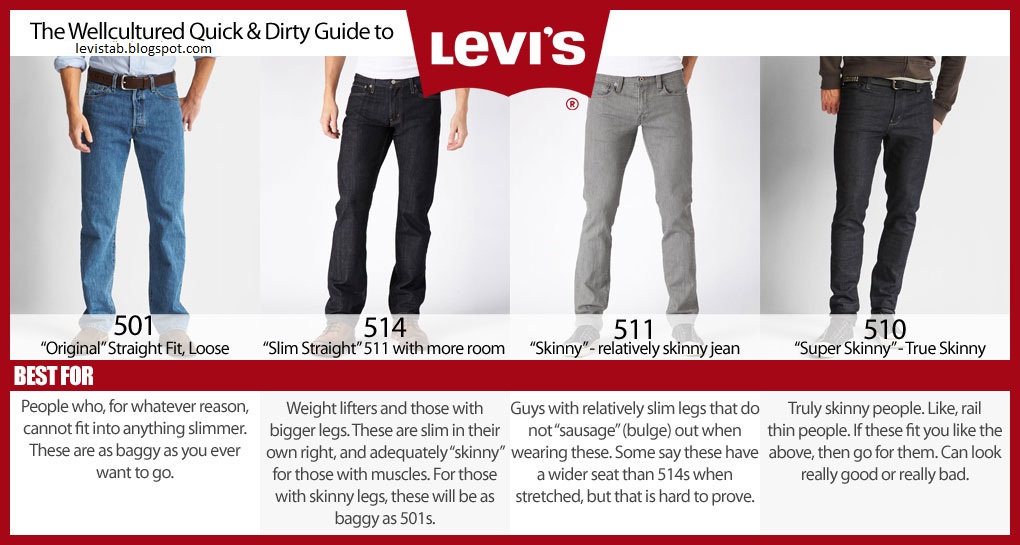
501 - 'Origanal' Straight Fit, Loose - Best For People who, for whatever reason cannot fit into anything slimmer. These are as baggy as you ever want to go
514 - "Slim Straight" 511 with more room - Best For Weight lifters and those with bigger legs. These are slim in their own right, and adequately 'skinny' for those with skinny legs, these will be as baggy as 501a
511 - "Skinny" - relatively skinny jean - Best For Guys with relatively slim legs that do not 'sausage' (bulge) out when wearing these. Some say these have a wider seat than 514s when stretched, but that is hard to prove.
510 - "Super Skinny" - truly Skinny - Best for truly skinny people. Like, rail thin people. If these fit you like above, then go for them. Can look really good or really bad
Levi’s 501 (Original Jean)
Sometimes jokingly called the “Obama Jean”
nowadays, 501s are the very classic Levi’s jean offering that has been
around for virtually forever. 501s are as baggy as a fashionable person
would ever want to go — they are relatively loose and relaxed and
perfect for a look trying to exploit that, but really often too loose
for most guys otherwise. Unless you have huge legs or are trying to pull
off something retro (or just have no other choice), 501s are probably
not an ideal choice.
Levi’s 514 (Slim Straight Jean)
These are pretty much the perfect balance between straight and skinny
— 514s are neither skinny nor baggy straight, making them a “slim
straight” that works fairly well for most people, particularly those
with bigger thighs (i.e. weightlifters). 514s don’t work very well for
those with super thin legs (they just manage to look baggy), but for
those with muscle tone, 514s are a godsend.
Levi’s 511 (Skinny Jean)
The canonical “skinny jean”, though admittedly they are really only
skinny in name. 511s differ from 514s in that they have a more drastic
taper and try to achieve a more skin-tight look without trying to be
too skin tight, making them a good choice for most guys with relatively thin legs. You can find a
ton
of variations on 511s, from ones with wild colors (like hot purple) to
material additions (like spandex to make the jean material less
constricting). These allegedly have a wider seat than the 514s (which is
really not something I’ve personally seen), so be wary.
Levi’s 510 (Super Skinny Jean)
510s are the honest-to-god Levi’s skinny jean. These can look amazing
on guys with very thin legs, or very horrible on guys with anything but
slim legs — if you don’t know if you could wear these, chances are you
shouldn’t wear them. 510s are skinny to the point where they look
ridiculous unless you are skinny all throughout to the point of looking
emaciated, so
be careful — these are wonderful jeans only in the right hands.
Some General Tips
- If you live in the United States, Levi’s can be purchased at a huge number of department stores. However, I personally feel one of the best options is the Amazon.com Levi store, which sells virtually all types of Levi’s for around $30/pair, which is an incredible steal.
- Consequently, if you live in Europe or outside of the US,
Levi’s will be much, much more expensive, and you may find a better
brand. Be wary — this guide is really meant for American users,
as Levi’s business model intentionally cuts the price of the jeans
stateside.
- As with virtually every other jean brand, waist size is directly correlated with the bagginess (or slimness) in the legs. Thus, focus on determining your waist size, and then experiment with the different styles listed above.
You can have drastically different leg sizes and fits with a size 32
waist — some people can wear 510s with a size 32 waist, others have to
go up to 514s, and so on.
- In the slimmer cuts (particularly 510s and 511s), the waist
can and likely will stretch ever so slightly, as will other parts of the
jean if they are really tight. This is not to imply you want
to buy jeans you have to use a shoehorn to get into, but in some cases
small amounts of tightness in the waist fix themselves after a little
bit of wear. The same rule applies to the thighs.
- Darker wash Levi’s — particularly the raws (obviously) and
the “rigid” brands — do develop fairly nice stacks, whiskering, and
general signs of individual wear. Obviously, the “rigid” Levi’s are not going to develop effects as nice as raws, but it’s a great alternative.
- No matter what people on other fashion websites/forums may say, there is no inherent status involved with waist size or the style of jeans you wear, pending they fit well. You don’t get fashion benefits for wearing 510s or anything like that.